
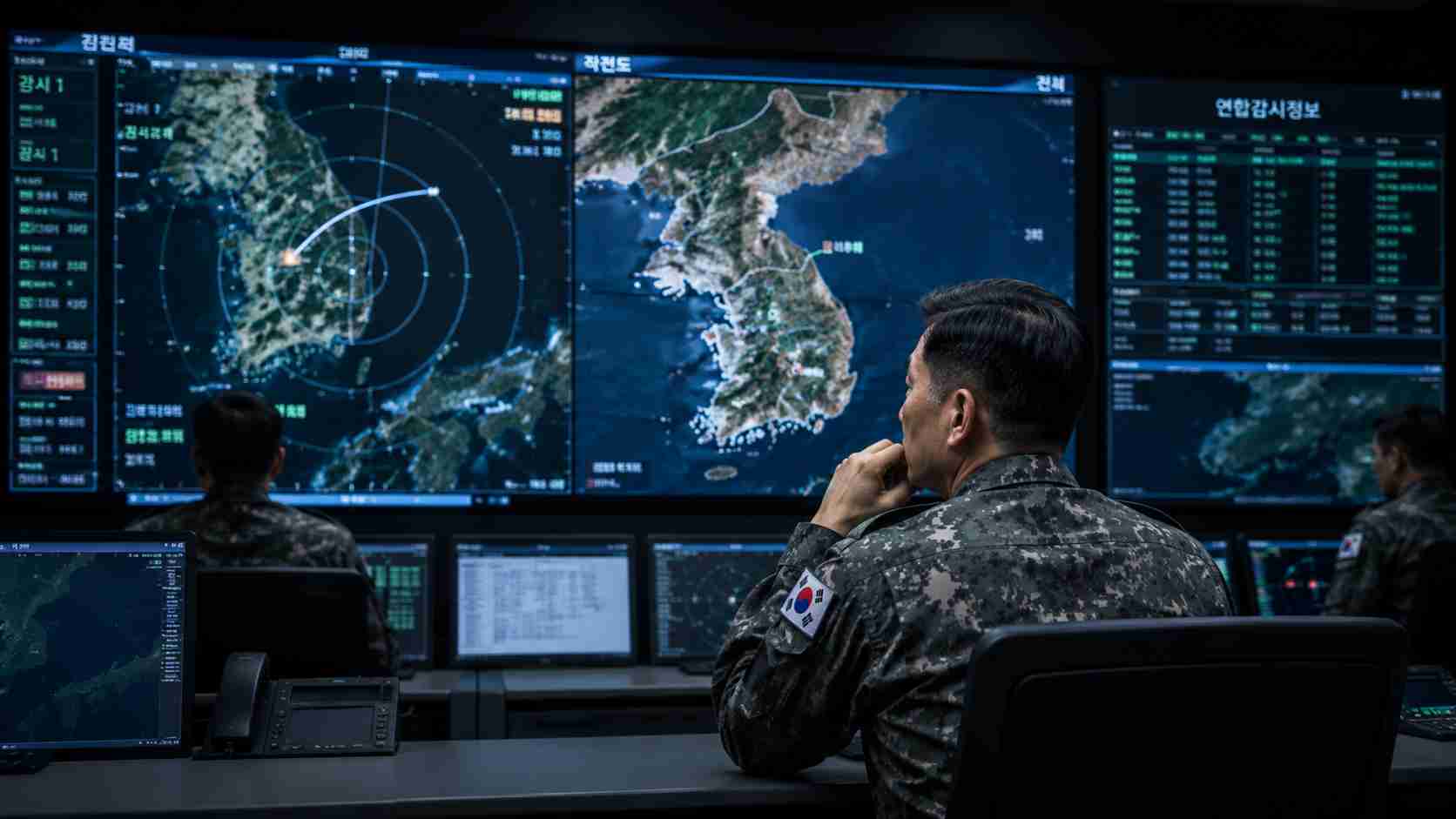
North Korea projectile activity off the country’s west coast drew a fresh security response from South Korea on Tuesday, May 26, 2026, after Seoul’s military reported a launch from the North Korean side of the Yellow Sea.
South Korea’s Joint Chiefs of Staff said North Korea had launched an unidentified projectile off its west coast. The first public details did not immediately establish the projectile’s type, range, flight path, or landing point.
The event matters because even a limited or unclear launch can force allied militaries to raise monitoring, coordinate intelligence and prepare for possible follow-on activity before all facts are known.
Context
North Korea has repeatedly used missile and projectile launches to display military capability, signal political defiance and test allied responses. The launches have often occurred during periods of regional tension or military activity involving South Korea, the United States and Japan.
The May 26 report followed earlier North Korean weapons activity in 2026, including missile launches reported in March during U.S.-South Korea military drills and additional weapons demonstrations in April.
North Korea’s weapons program remains a central security issue in Northeast Asia because its missile systems are designed to threaten South Korea, Japan and U.S. forces in the region. The country’s nuclear ambitions also complicate any diplomatic effort to reduce tensions.
Mechanism
A launch report from South Korea’s military usually triggers several immediate steps. Radar and surveillance systems attempt to identify the object, track its direction and assess whether it poses a direct threat to populated areas, vessels, aircraft, or allied bases.
Military authorities then compare data with U.S. and Japanese systems. That coordination matters because a projectile launched from North Korea can cross multiple surveillance zones within minutes.
At the public level, early statements often use cautious language such as “unidentified projectile” until analysts determine whether the object was a ballistic missile, cruise missile, rocket, artillery round, satellite vehicle, or another system.
Stakeholders
South Korea is the most directly exposed stakeholder because North Korean short-range systems can reach much of its territory. Seoul must respond quickly while avoiding language or action that could unnecessarily escalate the situation.
Japan is also affected because North Korean launches can move toward waters near Japan or pass through areas monitored by Japanese defense systems. Tokyo often issues its own assessments once flight data becomes clearer.
The United States is involved through its defense alliance with South Korea and Japan. Any North Korean launch can test how quickly the three countries share data and align their public message.
North Korea benefits from the attention generated by launches, especially when the technical details remain unclear at first. Uncertainty itself can create pressure on neighboring governments.
Data and Evidence
Reuters reported on May 26, 2026, that South Korea’s Joint Chiefs of Staff said North Korea had fired an unidentified projectile off its west coast. The initial report did not provide further details on the projectile’s type or trajectory.
The Associated Press reported the same day that South Korea said North Korea had launched multiple close-range ballistic missiles from Jongju, a city on the North’s west coast, into the sea. AP also reported that South Korea had strengthened surveillance and was exchanging information with the United States and Japan.
AP described the launch as North Korea’s first weapons launch event since April 19, 2026, when North Korea tested short-range missiles that state media later linked to cluster-bomb warheads.
Reuters separately reported that South Korea’s defense planning includes a goal of launching its first nuclear-powered submarine by the mid-2030s, a sign that Seoul is trying to strengthen long-term military capabilities against North Korean missile and submarine threats.
Analysis
The strongest explanation is that North Korea is using a limited launch to maintain pressure while avoiding an immediately confirmed major escalation. That pattern lets Pyongyang test military systems, measure allied reactions and keep regional security attention focused on its weapons program.
The uncertainty in the first South Korean statement is also important. When Seoul identifies an object only as an unidentified projectile, the immediate story is not just the launch itself but the assessment process that follows.
That process can shape markets, diplomacy and military posture. A confirmed ballistic missile launch carries different legal and diplomatic consequences than an artillery drill or a failed test.
The location matters as well. A launch from the west coast places attention on the Yellow Sea side of the peninsula, where military activity can affect South Korean readiness, shipping awareness and allied tracking.
Counterpoint
The main uncertainty is the precise nature of the projectile in the earliest public reporting. Initial military alerts are often revised as more radar, satellite and allied intelligence data becomes available.
It is also possible that the launch was intended primarily for domestic military development rather than an immediate diplomatic message. North Korea often frames weapons testing as part of its own defense modernization.
That distinction does not remove the security pressure on Seoul or Tokyo. But it does mean the launch should not be treated as proof of a broader military move unless official evidence supports that conclusion.
Consequence
The immediate consequence is heightened surveillance by South Korea and closer information-sharing with the United States and Japan. That response is routine, but it also raises the operational tempo around the peninsula.
The broader consequence is diplomatic friction. Each launch makes it harder to restart talks because neighboring governments must answer first-order security questions before they can discuss incentives, sanctions relief, or confidence-building steps.
For ordinary people in the region, the practical concern is simple: another launch means another round of alerts, military checks and uncertainty over what North Korea may do next.
What to Watch
The next question is whether South Korea, Japan, or the United States issue a more detailed technical assessment of the projectile’s type, flight distance and landing area.
A second point to watch is whether North Korean state media claims the launch as a successful test. Pyongyang’s official description can reveal whether the system was meant to demonstrate battlefield capability, naval reach, missile accuracy, or political resolve.
A third point is whether the launch is followed by additional activity. One isolated test would still matter, but a sequence of launches would create a larger readiness problem for Seoul and Tokyo.
Sources
North Korea fires unidentified projectile, South Korea military says — Reuters — May 26, 2026
North Korea launches ballistic missiles over the sea in latest show of force — Associated Press — May 26, 2026
South Korea aims to launch first nuclear-powered submarine by mid-2030s — Reuters — May 26, 2026