
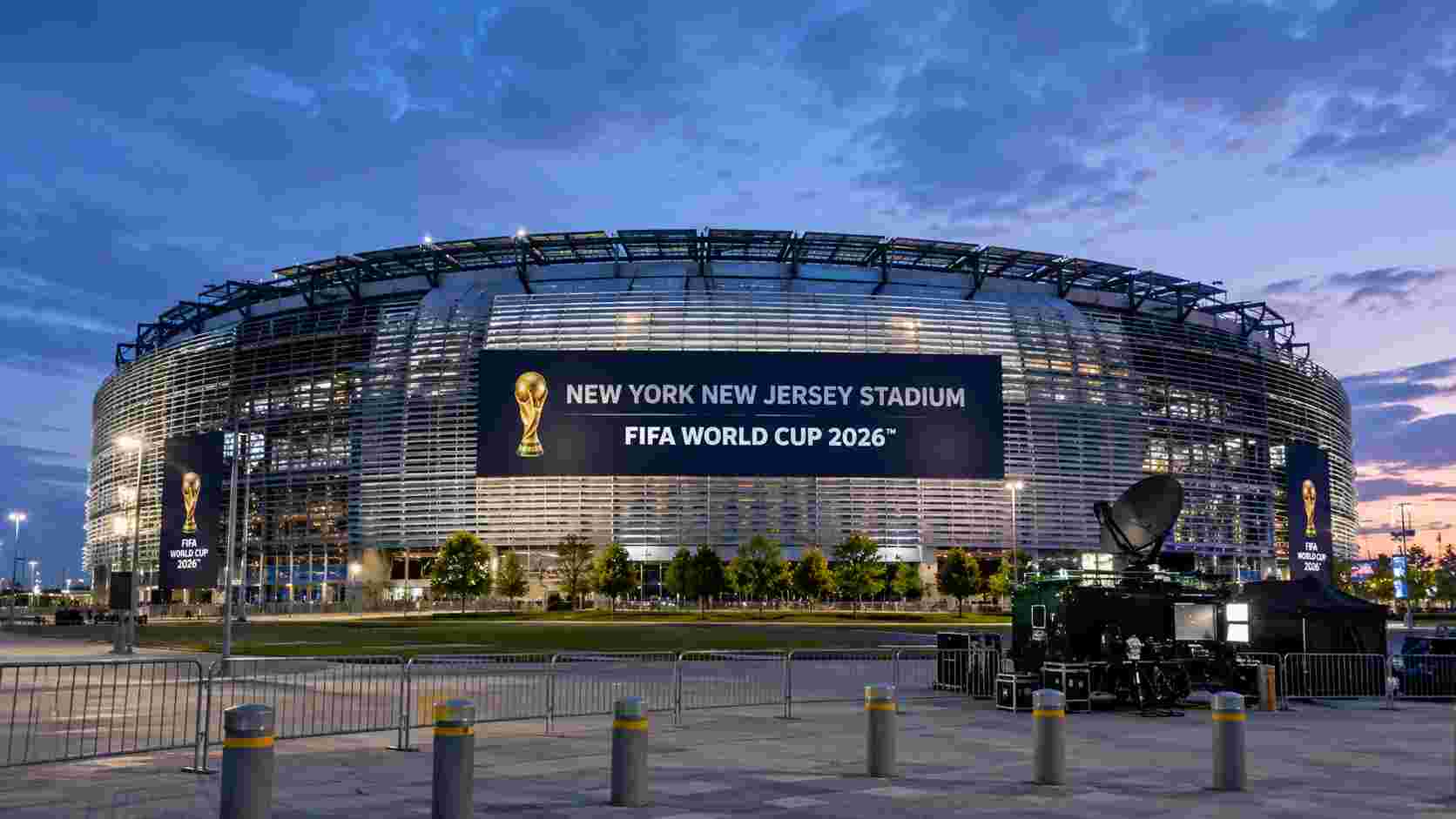
FIFA World Cup 2026 final planning is moving from schedule to operations, with the title match confirmed for July 19, 2026, at New York New Jersey Stadium in East Rutherford, New Jersey.
The venue is widely known as MetLife Stadium, but FIFA will use the tournament name New York New Jersey Stadium under its commercial and branding rules. That detail matters because the tournament is no longer only a future fixture list; host cities are now changing how stadiums look, operate, and present themselves before global broadcasts begin.
The latest developments connect three parts of the same event: the confirmed final site, FIFA’s 104-match schedule for a 48-team tournament, and visible preparation work at host venues such as Houston, where corporate signage is being removed or covered for the tournament window.
Context
The 2026 FIFA World Cup will be staged across the United States, Canada, and Mexico from June 11 to July 19, 2026. It is the first men’s World Cup planned for 48 teams and 104 matches, expanding the tournament’s scale far beyond the 32-team format used in recent editions.
FIFA has confirmed that New York New Jersey Stadium will host the final on Sunday, July 19. The New York New Jersey host page also lists eight matches for the market, including the final.
The final’s location gives the New York area the tournament’s closing moment, but the stadium’s official tournament identity shows how FIFA controls the commercial environment. During World Cup operations, venue names, visible sponsor marks, and certain stadium branding are adjusted to match FIFA requirements.
Mechanism
The clean-site model is a central part of FIFA’s event control. It is designed to protect tournament sponsors, standardize presentation across host venues, and reduce conflicting commercial branding inside areas that appear on broadcasts or are used by fans, media, teams, and officials.
In practice, that can mean covering, removing, or renaming visible corporate identifiers. Houston offers a current example: local reporting said crews began removing the NRG Stadium logo and other corporate marks ahead of the tournament, with the venue temporarily referred to as Houston Stadium under FIFA requirements.
The changes are not only cosmetic. They show that FIFA’s operational control period is beginning to affect stadium infrastructure, broadcast sightlines, and how local host committees coordinate with venue owners.
Stakeholders
FIFA benefits from a consistent commercial environment and cleaner global presentation. Official sponsors benefit because competing corporate marks are reduced in areas tied to the tournament product.
Host venues and local committees carry the operational burden. They must adapt buildings that normally serve NFL teams, concerts, college events, and local sponsors into FIFA-controlled tournament sites for a limited period.
Fans may notice practical changes in stadium names, signage, entry areas, and matchday branding. Local businesses and existing stadium partners may lose visibility during the event window, even though the World Cup can also bring tourism, media attention, and international foot traffic.
Players and national teams face a separate pressure point. As the final venue and schedule framework are settled, national-team selection decisions are becoming more intense, especially for high-profile players trying to prove fitness before squads are finalized.
Data and Evidence
The schedule framework published by FIFA covers 104 matches and 48 teams. FIFA’s official tournament hub lists the competition as running from June 11 to July 19, 2026, across Canada, Mexico, and the United States.
FIFA has confirmed the final for July 19 at New York New Jersey Stadium. The venue’s own event listing also shows the final scheduled for July 19, 2026, with a listed event start time of 3:00 p.m.
Houston’s clean-site work provides one of the clearest visible examples of tournament preparation. The Houston Chronicle reported on May 18, 2026, that crews were removing NRG Stadium branding and that the changes applied during FIFA’s control of the site.
Reuters also reported on May 17, 2026, that Neymar’s push for Brazil selection drew fresh attention after a botched substitution in Santos’ 3-0 loss to Coritiba. The report said Neymar was mistakenly taken off instead of Gonzalo Escobar after receiving calf treatment, and that Brazil coach Carlo Ancelotti had framed Neymar’s World Cup case around fitness and form rather than sentiment.
Analysis
The strongest explanation for these developments is that the 2026 World Cup has entered its conversion phase. The tournament is moving from calendar announcements into the hard work of turning existing stadiums into FIFA venues.
That shift creates tension because North American stadiums are built around naming rights, corporate partners, and year-round commercial use. FIFA’s system temporarily overrides that normal setup.
The final in New Jersey sharpens the issue because the closing match will be one of the most watched sports events in the world. FIFA has a strong incentive to make the venue look like part of a unified tournament rather than a normal NFL stadium with its usual commercial identity.
The Neymar storyline sits on a different track but reflects the same calendar pressure. With the tournament window approaching, every injury, club performance, and public incident can affect how coaches judge readiness.
Counterpoint
The clean-site changes should not be read as unusual conflict on their own. Major international tournaments commonly require host venues to follow strict commercial, security, and broadcast rules.
There is also a limit to what can be concluded from one player incident. Reuters reported that Neymar’s mistaken substitution was badly timed for his World Cup hopes, but selection still depends on Brazil’s staff, medical assessments, squad balance, and form across the full evaluation period.
For host venues, branding removal may be temporary and planned rather than disruptive. The larger uncertainty is how smoothly each city handles transport, crowd control, grass installation, security, and fan operations once matches begin.
Consequence
The confirmed final details give broadcasters, teams, fans, sponsors, and local officials a fixed end point for planning. New York New Jersey Stadium is now the venue around which the tournament’s closing logistics will be built.
Clean-site work means host cities are entering a more visible stage of preparation. Stadiums that normally carry local commercial identities are being reshaped into FIFA-controlled spaces.
For players, the consequence is more personal. The closer the tournament gets, the less room there is for ambiguity around fitness, form, and selection risk.
What to Watch
The next key signals will come from host-city conversion work, final venue operations, and national-team squad decisions. More stadiums are likely to show visible clean-site changes as FIFA control periods approach.
Transport planning around East Rutherford will also remain important because the final will concentrate global attention, security demands, and fan movement on one venue.
Brazil’s squad decisions will show whether Neymar’s experience, fitness claims, and recent Santos form are enough to overcome injury history and selection competition. The wider lesson is clear: the 2026 World Cup is no longer an abstract future event. It is now changing stadiums, schedules, and careers in real time.
Sources
New York New Jersey Stadium to host FIFA World Cup 2026 final — FIFA — February 4, 2024
World Cup 2026 match schedule, fixtures and stadiums — FIFA — March 30, 2026
FIFA World Cup 2026 tournament hub — FIFA — 2026
FIFA World Cup 2026 Final — MetLife Stadium — 2026
NRG name disappearing from stadium as crews remove branding in preparation for World Cup's clean site — Houston Chronicle — May 18, 2026
Neymar loses cool over botched substitution in final World Cup audition — Reuters — May 17, 2026
Neymar World Cup call based on fitness and form, not sentiment, Ancelotti tells Reuters — Reuters — May 12, 2026