
Opening
US factory PMI rose to a 48-month high in May 2026, but the stronger manufacturing signal came with a warning sign for inflation.
S&P Global said its flash U.S. Manufacturing Purchasing Managers' Index climbed to 55.3 in May from 54.5 in April, the highest reading since May 2022. The data were collected from May 12 to May 20 and released on May 21.
The headline suggests factories are expanding. The concern is that part of the strength came from companies buying and holding more inputs to protect themselves from supply delays and future price increases linked to the war in the Middle East.
Context
A PMI reading above 50 indicates expansion compared with the prior month, while a reading below 50 indicates contraction. S&P Global's flash PMI is an early reading based on most, but not all, monthly survey responses.
The May report showed a split economy. Manufacturing improved, while services remained weak enough to leave the broader composite output index unchanged at 51.7.
That matters because manufacturing can look healthy when companies pull forward purchases. A rush to build inventories can lift production and orders now, while leaving open the risk that later demand slows once shelves and warehouses are full.
Mechanism
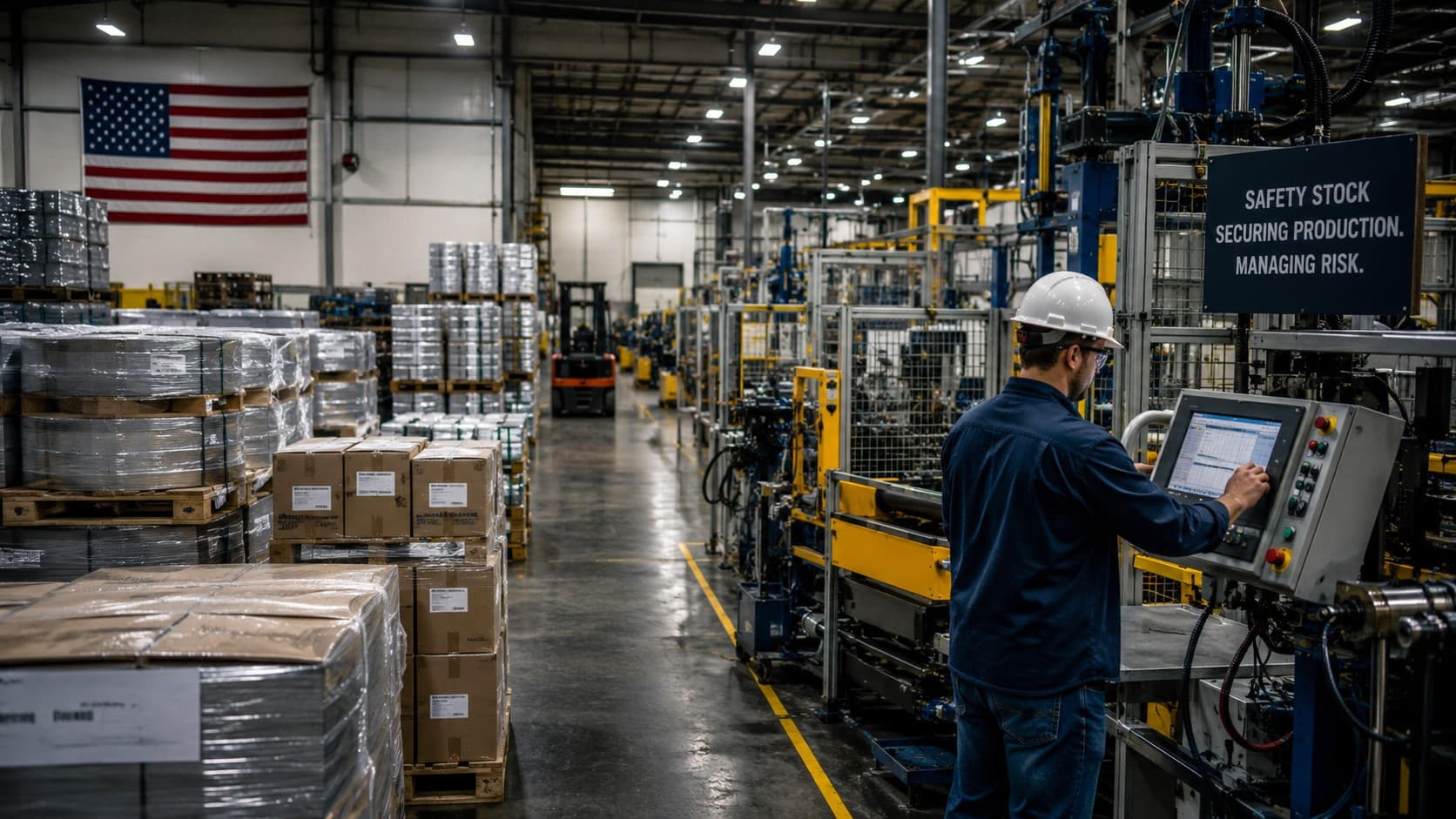
The mechanism behind the May reading was not just stronger factory demand. It was also defensive behavior.
S&P Global said manufacturing output grew at the fastest pace in just over four years. But it also said the inflow of new orders partly reflected precautionary stock building by clients, while goods exports fell again.
Factories also bought more inputs. S&P Global reported that the amount of inputs purchased by factories rose at the steepest rate since April 2022, pushing input inventories higher.
That means some of the PMI gain reflects companies ordering earlier, ordering extra, or holding more materials than usual. In plain terms, firms were filling storerooms because they feared parts, fuel, and shipping could get harder or more expensive.
Stakeholders
Manufacturers benefit in the near term because stronger output, orders, and purchasing support factory activity. Workers in manufacturing also saw a better picture than workers in services, with factory payrolls showing the largest rise for 11 months.
The pressure falls on buyers, suppliers, and consumers. Supplier delivery times lengthened to the greatest degree since August 2022, meaning companies had to wait longer for parts and materials.
Consumers are exposed because higher input costs can move into final prices. Investors are exposed because sticky price pressure can complicate expectations for interest rates, bond yields, and corporate margins.
Data and Evidence
The central figure was the flash U.S. Manufacturing PMI at 55.3 in May, up from 54.5 in April and its highest since May 2022.
S&P Global also reported the flash Manufacturing Output Index at 56.2, up from 56.0 in April and a 49-month high. The composite output index was unchanged at 51.7, while the services business activity index slipped to 50.9 from 51.0.
The pricing details were the more uncomfortable part of the report. S&P Global said input price inflation surged to its highest since November 2022, while manufacturing input costs registered their largest monthly increase since June 2022.
The report's price charts showed the manufacturing input-price gauge rising to 79.5 from 68.4 in April, and the manufacturing output-price gauge rising to 63.3 from 61.7. Those readings point to a renewed inflation pulse inside the factory sector.
Analysis
The strongest reading of the report is that U.S. factories were active, but not in a clean, demand-led boom.
The data show a mix of real production growth, domestic demand, precautionary buying, longer supplier lead times, and sharper price increases. That combination can support activity while also raising costs.
Chris Williamson, chief business economist at S&P Global Market Intelligence, warned that the economy would struggle to manage annualized GDP growth of much more than 1% in the second quarter. He also said the boost from precautionary stock building would not last forever.
The report therefore fits a difficult macro picture: growth is not collapsing, but price pressure is not fading smoothly. That is the kind of mix that can unsettle investors who are looking for clear evidence that inflation is cooling.
Counterpoint
The counterpoint is that PMI data are surveys, not hard production totals. Flash readings are preliminary, and final May manufacturing data were scheduled for publication on June 1.
A higher PMI also still signals improvement in factory conditions. Manufacturing output accelerated, job creation improved in factories, and manufacturers were more optimistic than service companies about the year ahead.
It is also possible that stockpiling prevents worse disruptions. If supply routes remain strained, holding extra inputs can keep production lines moving and protect customers from shortages.
Consequence
The consequence is that the May PMI report gives policymakers and markets less comfort than the headline alone suggests.
A four-year high in manufacturing activity would normally point to resilience. But when that strength is tied to safety stocks, supply delays, and higher costs, it can also signal that inflation risk is rebuilding beneath the surface.
For businesses, the practical issue is cash and planning. Buying more inventory ties up money, and higher input bills can force companies to raise prices, accept thinner margins, or delay investment.
What to Watch
The next test is whether the final May manufacturing PMI confirms the flash reading on June 1.
Investors will also watch whether supplier delivery times keep worsening, whether input costs remain elevated, and whether output prices continue to rise. Those details will matter more than the headline number alone.
The larger question is whether stockpiling fades before demand weakens. If the inventory boost wears off while prices stay high, the economy could face slower growth with a more persistent inflation problem.
Sources
Sources = S&P Global Flash US PMI — S&P Global Market Intelligence — May 21, 2026
Sources = US manufacturing activity rises to four-year high in May, S&P Global survey shows — Reuters — May 21, 2026