
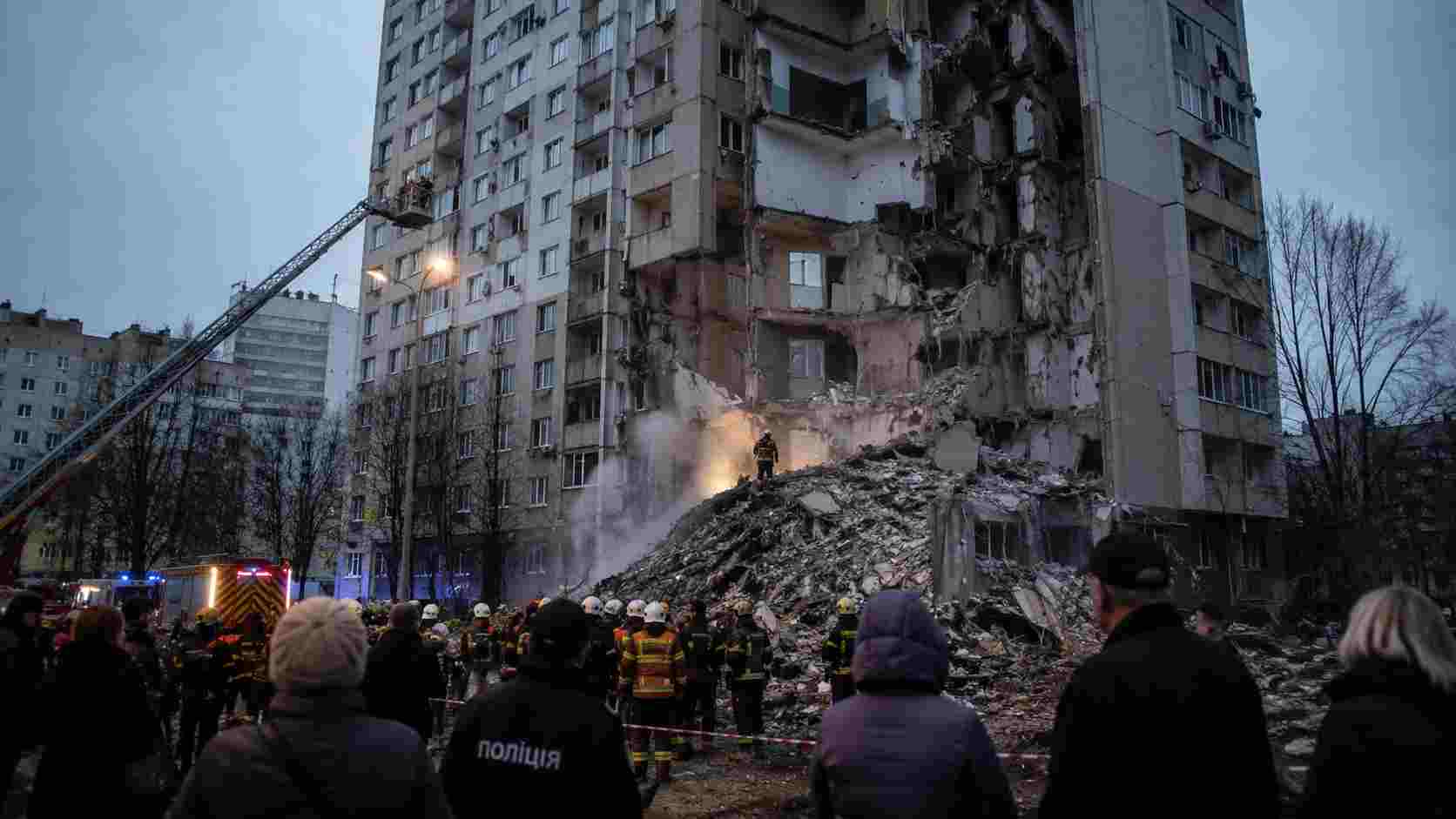
Kyiv apartment strike casualties reached 24 after a Russian missile hit a nine-story residential building in Ukraine’s capital on May 14, 2026, according to Ukrainian officials and international reporting.
The dead included three children, and nearly 50 people were wounded. Kyiv declared May 15 a day of mourning as rescue crews ended a long search through the rubble and residents faced the loss of an entire section of the building.
President Volodymyr Zelenskiy visited the site, laid flowers, and said Ukraine had approved certain response formats. That signal matters because a deadly strike on civilians is now tied directly to possible Ukrainian long-range retaliation against Russian targets.
Context
Russia has repeatedly used missiles and drones against Ukrainian cities since the full-scale invasion began in February 2022. Moscow denies deliberately targeting civilians, but residential buildings, power infrastructure, ports, and public facilities have been hit throughout the war.
The Kyiv strike came during one of the heaviest aerial barrages of the conflict. Ukrainian officials said Russia launched more than 1,500 drones and dozens of missiles over roughly two days, while reporting damage across scores of sites.
The attack also landed at a delicate diplomatic moment. Recent ceasefire proposals and claims of possible progress have been undercut by continuing strikes, accusations of violations, and uncertainty over whether either side sees restraint as militarily useful.
Mechanism
The immediate mechanism was a missile strike on an apartment block in Kyiv’s Darnytskyi district. Ukrainian officials said the impact destroyed a full vertical section of the building from the first through ninth floors.
Emergency workers searched through thousands of cubic meters of debris for more than a day. About 30 people were rescued alive, while authorities said hundreds of residents and relatives required psychological support.
The broader mechanism is the interaction between air attack and retaliation. Russia’s missile and drone campaign is meant to pressure Ukrainian cities, stretch air defenses, and demonstrate that the rear remains vulnerable. Ukraine’s response options, including long-range drone and missile activity, are meant to impose costs inside Russia and disrupt energy or military infrastructure.
Stakeholders
The most immediate stakeholders are the families of the dead and the people forced out of damaged homes. For them, escalation is not an abstract word; it means funerals, broken stairwells, missing neighbors, and the fear that another night alarm could bring the same result.
Ukraine’s government is under pressure to show that civilian deaths will produce consequences for Russia. Zelenskiy’s remarks speak to both domestic grief and a strategic need to prove that Ukraine can answer strikes beyond defensive interception.
Russia faces the risk that continued mass attacks will draw deeper Ukrainian strikes into its own territory and strengthen arguments for more Western air-defense and long-range support to Kyiv. Western governments are also stakeholders because they must decide whether civilian casualties justify tighter sanctions enforcement, more weapons deliveries, or renewed diplomatic pressure.
Data and Evidence
Ukrainian officials said 24 bodies were recovered from the Kyiv building, including three children. Reuters reported that nearly 50 people were wounded and about 30 were rescued alive.
The Ukrainian president’s office said the Russian missile destroyed an entire section of the residential building from the first to the ninth floor. Associated Press reported that the strike occurred during what Ukraine’s air force described as Russia’s largest barrage of the country since the full-scale invasion.
Reporting also placed the strike alongside Ukrainian drone attacks on targets inside Russia, including the Ryazan oil refinery. Russian authorities said people were killed or wounded in those retaliatory attacks, while Ukraine framed its response as a consequence of Russia’s continued bombardment.
Analysis
The strongest explanation is that both sides are using long-range fire to change the cost calculation of the war. Russia is trying to make Ukraine’s cities feel permanently exposed, while Ukraine is trying to show that Russian territory, logistics, and energy assets are not insulated from the conflict.
That creates a dangerous ladder. A strike on a residential block increases public pressure on Kyiv to respond. A Ukrainian strike inside Russia then gives Moscow another pretext to widen its own attacks, even as it denies deliberately targeting civilians.
The timing also weakens ceasefire mechanics. A truce depends on confidence that violations will be limited, attributable, and politically containable. A mass-casualty strike on Kyiv makes that much harder because restraint can look like weakness to audiences on both sides.
Counterpoint
There is still uncertainty over the exact military targets involved in the wider barrage and the operational details of Ukraine’s approved response formats. Zelenskiy’s statement signals intent and authorization, but it does not by itself confirm every target, weapon, or timeline.
Russia continues to deny intentionally targeting civilians. That denial is not enough to erase the civilian death toll, but it remains part of the contested information environment surrounding each strike.
There is also a diplomatic counterpoint. Even after deadly attacks, prisoner exchanges and talks can continue in parallel with fighting. The war has repeatedly shown that battlefield escalation and narrow negotiations can happen at the same time.
Consequence
The immediate consequence is mourning in Kyiv and renewed pressure on Ukraine’s leadership to respond. The larger consequence is an increased risk that long-range attacks become a central tool of escalation rather than an exception.
For civilians, that means air defenses, shelters, evacuation decisions, and emergency services remain central to daily survival. For governments, it means every new strike may shape weapons policy, sanctions enforcement, and the political space for ceasefire talks.
The strike also sharpens the question facing Ukraine’s partners: whether condemnation is enough when the same pattern of attacks continues, or whether additional air-defense systems and constraints on Russian weapons supply chains are necessary.
What to Watch
Watch whether Ukraine carries out further long-range strikes against Russian energy or military targets in the coming days. The specific targets will show whether Kyiv is trying to signal punishment, disrupt logistics, or impose broader economic costs.
Watch how Moscow responds. A larger missile or drone wave against Ukrainian cities would indicate a renewed escalation cycle, while a narrower response could suggest an attempt to manage risk.
Also watch Western capitals. New air-defense pledges, sanctions enforcement against missile components, or statements about long-range weapons would show whether the Kyiv apartment strike changes policy or only produces another round of condemnation.
Sources
Zelenskiy vows retribution after Russian strike on housing block kills 24 — Reuters — May 15, 2026 Kyiv mourns as death toll from Russian attack in the Ukrainian capital rises to 24 — Associated Press — May 15, 2026 The President Honored the Memory of Those Killed in the Russian Strike on a Residential Building in Kyiv on May 14 — Office of the President of Ukraine — May 15, 2026 We Must Respond to Russian Strikes in a Just and Tangible Way; I Approved Certain Response Formats — Office of the President of Ukraine — May 15, 2026 After Russia's Kyiv attack leaves 24 dead, Zelensky instructs military to prepare response — The Kyiv Independent — May 15, 2026 Ukraine attacks Russia with drones after suffering three days of massive strikes — The Guardian — May 15, 2026