
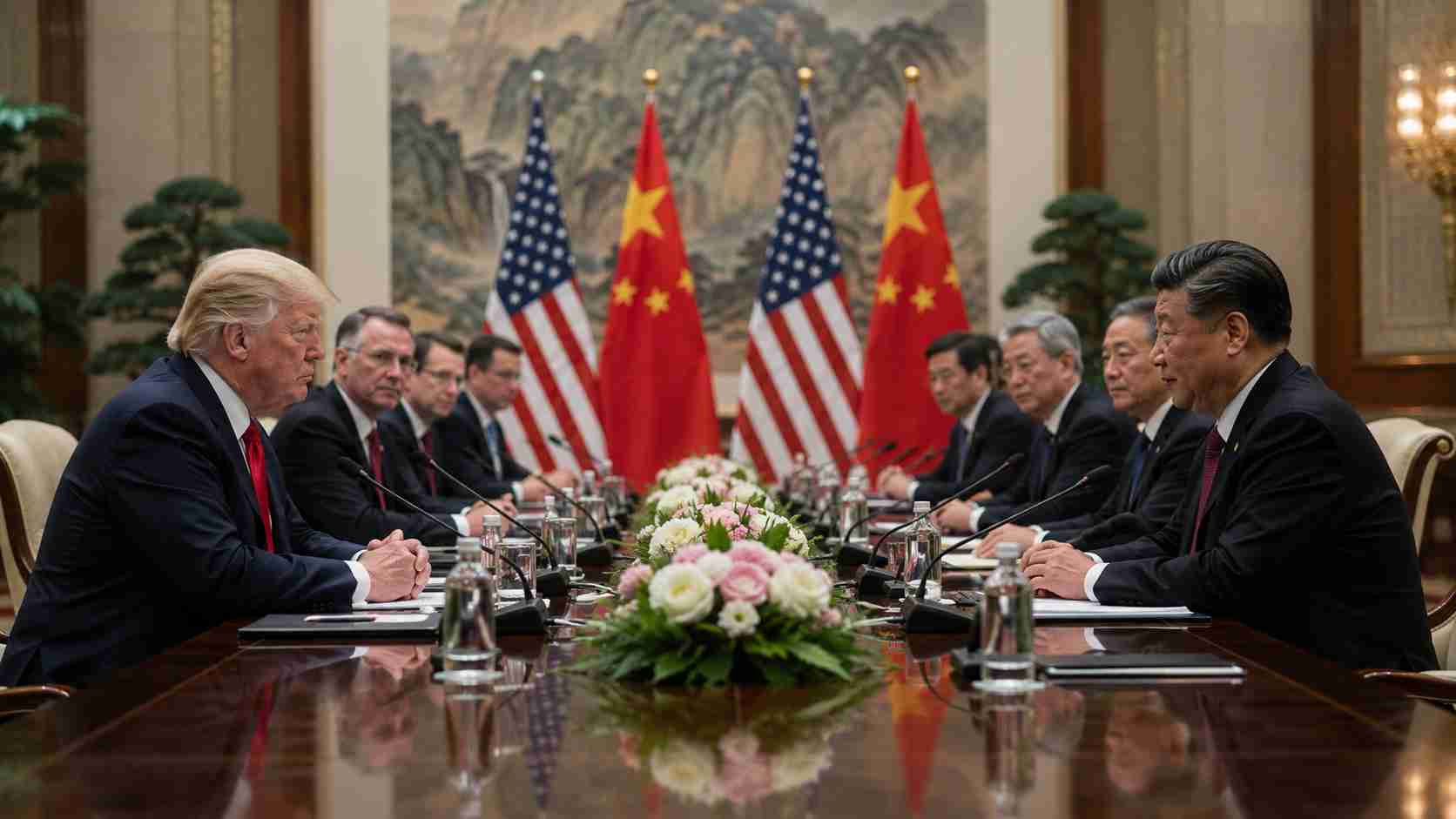
Trump-Xi talks in Beijing opened with the Iran war, trade and Taiwan all competing for priority as President Donald Trump sought China’s help in containing a conflict that has already shaken energy markets and global supply chains.
Trump arrived in Beijing on May 13, 2026, for a two-day summit with Chinese President Xi Jinping, according to AP and Reuters reporting. The talks come as Washington looks for leverage over Iran, while Beijing weighs its own interests in Gulf energy flows, U.S.-China trade tensions and Taiwan.
The central issue is not only whether China can influence Iran. It is whether Beijing is willing to use that influence while also pressing Washington on disputes that matter deeply to China.
Context
The summit is taking place at a moment when the Iran war has moved from a regional security crisis into a global economic problem. Disruption around the Strait of Hormuz has raised fears about oil and liquefied natural gas flows, shipping insurance, inflation and industrial supply chains.
China is central to that equation because it is a major buyer of Middle Eastern energy and has diplomatic channels with Tehran. That gives Beijing a possible role in any effort to reduce shipping risk or revive stalled peace talks.
At the same time, the U.S.-China relationship remains strained by tariffs, technology controls, market access disputes and military pressure around Taiwan. That means any discussion of Iran is unlikely to stand alone.
Mechanism
Trump’s leverage depends on persuading Xi that a wider Iran war would harm China’s own economy. Higher energy prices, disrupted shipping and weaker demand in export markets could all damage Chinese growth.
China’s leverage runs through diplomacy, energy demand and trade. Beijing can speak to Tehran in ways Washington cannot, but it can also demand that U.S. concerns about Iran be weighed against Chinese concerns about Taiwan, tariffs and technology restrictions.
That creates a complicated bargain. The United States wants China to help reduce war risk. China may want the United States to soften pressure in areas Beijing sees as core national interests.
Stakeholders
The immediate stakeholders are the United States, China, Iran and Taiwan. But the consequences extend far beyond those governments.
Oil importers, airlines, shipping firms, manufacturers and central banks are exposed to the outcome. If Hormuz risk eases, energy prices and inflation expectations could cool. If the summit produces no signal, traders may price in a longer disruption.
Consumers are also stakeholders, though indirectly. Fuel, freight and food costs can rise when energy and fertilizer-linked supply chains are strained.
Data and Evidence
AP reported that Trump arrived in Beijing on May 13, 2026, for a summit with Xi at a moment shaped by war, trade and artificial intelligence. Reuters reported that the Beijing talks were expected to include Iran, trade and Taiwan.
China’s Foreign Ministry said on May 11, 2026, that China’s position on Iran was consistent and that Beijing would continue playing a positive role in promoting peace talks and ending the conflict.
The International Energy Agency’s Oil Market Report for May 2026, published on May 13, described the oil market as facing major disruption. Reuters, citing the IEA, reported that global oil supply was projected to fall short of demand by 1.78 million barrels per day in 2026 because of the Iran war and related disruptions.
UNCTAD warned in March 2026 that disruption in the Strait of Hormuz had implications for global trade and development, noting that energy markets reacted quickly and that Brent crude had risen above $90 per barrel at that point.
Analysis
The strongest explanation for the summit’s importance is that Iran has become a test of U.S.-China crisis management. Washington and Beijing disagree sharply on trade, technology and Taiwan, but both have reasons to avoid an energy shock that damages global demand.
That shared interest does not make cooperation easy. China may prefer a limited diplomatic role that protects its image as a mediator without appearing to act under U.S. pressure. Trump, meanwhile, needs visible progress that can be presented as pressure on Iran or movement toward de-escalation.
The market impact will likely depend less on broad language and more on concrete signals. Traders will watch whether China says it will press Iran, whether Washington changes its tone on Taiwan or trade, and whether either side points to a process for reopening safer shipping routes.
Counterpoint
There is a serious limit to what the summit can achieve. China’s influence over Iran is real but not absolute, and Tehran’s military and political calculations may not shift because Beijing asks for restraint.
There is also no confirmed public agreement showing that China will trade pressure on Iran for U.S. concessions on Taiwan or tariffs. Analysts have discussed that possibility, but it remains an assessment rather than a verified outcome.
Another uncertainty is whether markets have already priced in part of the disruption. If traders expect prolonged risk, even a positive diplomatic statement may not move prices unless it is backed by visible changes in shipping conditions.
Consequence
The summit ties three pressure points into one diplomatic moment: war in the Middle East, economic competition between the world’s two largest economies and Taiwan’s security environment.
For markets, the consequence is immediate. A credible sign that Beijing will support de-escalation could reduce some risk premium in oil and commodities. A vague or confrontational outcome could reinforce fears that the Iran war will keep feeding inflation and supply-chain strain.
For diplomacy, the consequence is broader. If the United States needs China’s help on Iran, Beijing may gain more room to press its own priorities.
What to Watch
The first thing to watch is whether the two governments issue a joint statement or separate readouts mentioning Iran, Hormuz shipping or peace talks.
The second is whether China announces direct diplomatic contact with Iran after the summit. That would be a stronger signal than general language about peace.
The third is whether Taiwan appears in the official language. Any shift in tone around U.S. arms sales, military activity or cross-strait stability would show whether the Iran discussion has spilled into the wider U.S.-China bargain.
The fourth is the market reaction. Oil prices, shipping insurance costs, LNG prices and inflation-linked bond moves will show whether investors believe the summit changed the risk around energy supply.
Sources
Trump-Xi summit live: Talks in Beijing include Iran, trade and Taiwan — Reuters — May 14, 2026 Trump arrives in Beijing for talks with China’s Xi on Iran war, trade and US arms sales to Taiwan — Associated Press — May 13, 2026 Foreign Ministry Spokesperson Guo Jiakun’s Regular Press Conference on May 11, 2026 — Ministry of Foreign Affairs of the People’s Republic of China — May 11, 2026 Oil Market Report - May 2026 — International Energy Agency — May 13, 2026 Global oil supply to plunge below demand this year due to Iran war, IEA says — Reuters — May 13, 2026 Strait of Hormuz disruptions: Implications for global trade and development — UNCTAD — March 10, 2026