
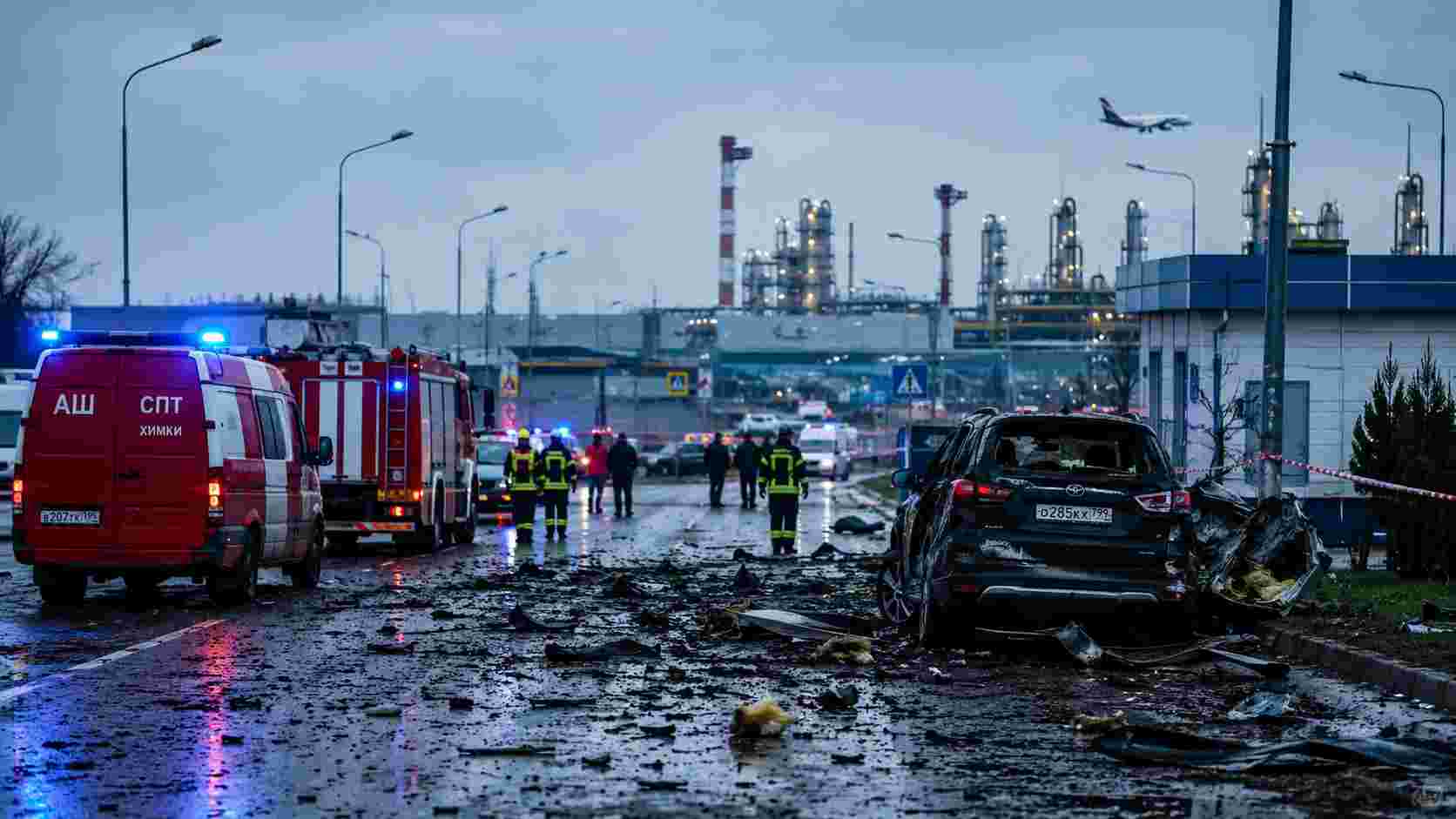
Ukraine drone strikes killed at least four people in Russia overnight into May 17, 2026, according to Russian officials cited by Reuters and the Associated Press, as Moscow faced what Reuters described as its biggest Ukrainian drone attack in more than a year.
Russia’s defence ministry said air defences downed 556 Ukrainian drones across the country overnight and into the morning. Moscow Mayor Sergei Sobyanin said 81 drones were destroyed while heading toward the capital after midnight, according to Russian state reporting cited by Reuters.
The reported attack matters because it shows how the war’s long-range drone campaign is moving pressure deeper into Russian territory, including around Moscow, oil infrastructure and major transport hubs.
Context
Ukraine and Russia have both expanded drone warfare since Russia’s full-scale invasion of Ukraine in February 2022. Russia has repeatedly launched missiles and drones at Ukrainian cities and energy sites, while Ukraine has increasingly used long-range drones to strike military, energy and logistics targets inside Russia.
Kyiv usually does not immediately confirm specific strikes on Russian territory. That makes attribution dependent on Russian official statements, Ukrainian silence or later comment, and reporting by international news agencies.
The May 17 attack came after repeated Russian strikes on Ukrainian cities and infrastructure. Reuters reported that the latest wave represented the largest attack on Moscow in more than a year, based on the number of drones reported intercepted around the capital.
Mechanism
The attack appears to have relied on large numbers of unmanned aerial vehicles launched toward multiple Russian regions, including the Moscow area. Russia’s defence ministry said 556 drones were downed across the country, while officials in Moscow reported dozens intercepted near the capital.
Air defence claims cannot be independently verified in full during active wartime reporting. The number also reflects drones Russia says it intercepted, not necessarily the total number launched or the number that reached targets.
Debris from intercepted drones can still cause deaths, injuries and property damage. That is why even a high interception rate does not remove the risk to civilians, airports, refineries or residential areas.
Stakeholders
Russian civilians in the Moscow region faced the most immediate risk. Regional officials reported deaths in Khimki and Pogorelki, with damage to homes and injuries linked to the strikes.
The Russian government is under pressure to defend the capital region and protect critical infrastructure. A large drone wave around Moscow carries political weight because it challenges the image of distance between the front line and daily life in the Russian capital.
Ukraine’s military and political leadership may see deep strikes as a way to impose costs on Russia, stretch air defences and respond to attacks on Ukrainian cities. But civilian casualties inside Russia also create legal, diplomatic and information-war risks, especially when targets and damage are disputed.
Airports, refinery operators and local emergency services are also affected. Moscow’s Sheremetyevo Airport said drone debris fell on its grounds without causing damage, while Sobyanin said most injuries occurred near the entrance to Moscow’s oil refinery and that the refinery’s core technology was not damaged.
Data and Evidence
The core figures reported on May 17 are significant. Russian authorities said at least four people were killed: three in the Moscow region and one in the Belgorod region. The Associated Press reported that one woman was killed in Khimki, two men were killed in Pogorelki, and another man died in Belgorod when a drone hit a lorry.
Sobyanin said 12 people were injured, mostly near the entrance to Moscow’s oil refinery. He also said three houses were damaged and that the refinery’s technology was not damaged.
Russia’s defence ministry said 556 drones were downed nationwide overnight into the morning. Reuters, citing Russian state media and Moscow officials, reported that 81 drones headed toward Moscow had been destroyed since midnight.
Sheremetyevo Airport, Russia’s largest airport, said drone debris fell on its territory without causing damage. That detail is important because it shows the attack affected areas around key transport infrastructure even when officials reported no major airport damage.
Analysis
The strongest explanation is that Ukraine’s long-range drone campaign is being used to stretch Russian air defences and bring the costs of war closer to strategic and symbolic locations. Moscow is not just another city in this context; it is the seat of Russia’s government, a transport hub and a major communications symbol.
The reported scale of 556 downed drones suggests a saturation approach. Large waves can force defenders to spread radar coverage, interceptor systems and emergency responses across many locations at once.
The casualties also show the risk of drone warfare in dense civilian areas. Even when strikes are aimed at infrastructure or when drones are intercepted, debris, navigation failure or air defence impacts can kill people far from any battlefield.
Counterpoint
The main uncertainty is that most operational details come from Russian official statements. Wartime governments often emphasize successful interceptions, limit details about damage, and frame attacks to support their own public narrative.
Ukraine had not publicly confirmed responsibility for each reported impact at the time covered by the reports. Without independent access to all strike locations, the exact launch count, target list and damage pattern remain unclear.
There is also a serious legal and ethical question around strikes that risk civilian harm. Even when a state argues that it is targeting military or energy infrastructure, attacks near homes, airports and urban refineries can expose civilians to danger.
Consequence
The immediate consequence is a higher casualty toll inside Russia and renewed scrutiny of Moscow’s air defences. The attack also signals that Russia’s rear areas, including the capital region, remain vulnerable despite layers of air defence.
For Ukraine, the strikes may increase pressure on Russian logistics and public confidence, but they may also invite retaliation. Russia has repeatedly answered Ukrainian long-range attacks with major missile and drone strikes on Ukrainian cities and infrastructure.
For civilians on both sides, the result is a war that is becoming more technologically dispersed. Drones make distance less protective, and ordinary people can be exposed to danger even far from front lines.
What to Watch
The next key question is whether Ukraine confirms or claims any part of the operation. Kyiv’s public posture will matter because it shapes how the strike is understood internationally and whether specific targets can be assessed.
The second issue is whether Russia revises the casualty or damage figures. Early wartime reports often change as emergency services inspect damaged homes, industrial sites and transport facilities.
The third issue is retaliation. Any large Russian response against Ukrainian cities or energy infrastructure would show whether the May 17 drone wave becomes part of another escalation cycle.
Finally, watch for changes around Moscow’s airports, refinery security and regional air defence deployments. A major drone wave does not have to destroy a facility to force new costs, delays and defensive adjustments.
Sources
Ukraine drones kill four in Russia, Moscow faces biggest attack in over a year — Reuters — May 17, 2026 At least 4 people killed in one of the largest Ukrainian drone strikes on Russia — Associated Press — May 17, 2026 Ukraine war briefing: more than 500 drones strike at Russia, killing 3 — The Guardian — May 17, 2026